
Hume Band review: everything you need to know about this smart health tracker

I’ve been exploring health trackers that actually help you live longer, not just notify you of every ping. Hume Band, Hume Health’s latest smart band, does exactly that – it focuses on meaningful health insights over typical smartwatch distractions. Branded as a personal longevity coach, it turns biometrics into scores like Metabolic Capacity and Metabolic Momentum, with optional AI coaching – all without a subscription.For transparency, this review draws on official specs, research, and user experiences rather than hands-on testing.
Quick overview of Hume Band
Here is a quick overview table with key information about Hume Band. I’ve also made some notes about what I like and don’t like about Hume Band below the table.
| Overall rating | 4.8 |
| Pricing | One-time purchase is $229.04. Optional premium membership starts at $8.99/month (or $99.00/year). No subscription required to access your data. |
| Brief description | A longevity-focused smart band that tracks core biometrics and converts them into unique metrics like Metabolic Capacity and Metabolic Momentum. |
What is Hume Band?
The Hume Band is a wrist strap with built-in electronics and sensors that continuously collect biometric and physiological data. The black, adjustable strap is made from a SuperKnit fabric that fits a wide range of wrist sizes. Hume Health says it’s dustproof and water-resistant up to one meter for up to two hours. It’s also FCC-certified and EMF-safe, or safe from electromagnetic fields.
In terms of design, it’s minimal and screenless like WHOOP and the Amazfit Helio Strap. According to the company, its sensor array captures health signals more frequently than many consumer devices, and this setup has been tested in the laboratory by independent testers. Though I didn’t find detailed independent results shared publicly.
The Hume Band’s promise is clear: continuous health monitoring without notifications, additional apps, or distractions, and most importantly, a longevity focus. In fact, Hume Health claims that the average Hume Band user gained an extra 39 days of extra life in their first year using the product. However, this figure is based on estimates rather than real-world clinical data. It should be understood as a marketing claim derived from projections, not a medically validated or empirically proven result.
Like other wearables, the free companion app, Hume Health, is required for insights and configuration.
How does the Hume Band work?
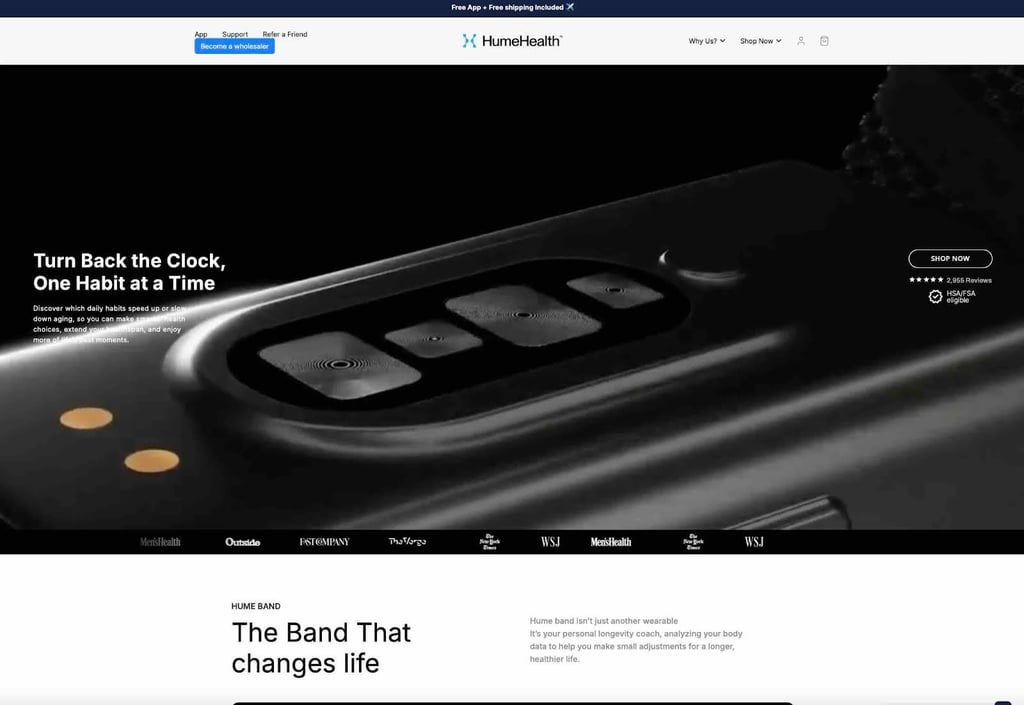
Hume Band uses five LEDs and four photodiodes to continuously read wrist signals and extract core metrics, including heart rate, its variability (HRV), and oxygen saturation (SpO2). That data is translated into key longevity indicators, such as Metabolic Capacity (how efficiently your body performs and recovers) and Metabolic Momentum (whether your habits are adding years to your life).
The company also says Hume Band can help identify potential health issues early like sleep apnea, when SpO2 drops below a set level multiple times, with added heart rate fluctuations. Blood pressure is another feature that’s in the works. However, it’s important to highlight that the Hume Band is a wellness tool and should never replace medical evaluations done by professionals or medical gadgets issued for specific health-related issues.
Your data goes to the Hume Health app via Bluetooth LE, where visual gauges represent your Metabolic Capacity, Metabolic Momentum, and Health Score. The app also integrates with Apple Health and Google Fit, but that should be enabled in the Connected Apps section. Data export isn’t currently available. With Premium ($8.99/month), you unlock personalized AI coaching, feedback, and a free Hume Band upgrade every two years.
Hume Band metrics tracked
Below is a quick look at the core metrics of the Hume Band tracks. While the device measures 16 data points overall, these are the most relevant for everyday health insights:
| Metric | Function | Why it may be useful |
| Heart rate | Measures beats per minute throughout the day | Helps track fitness, stress, and overall cardiovascular activity |
| Resting heart rate (RHR) | Baseline heart rate during rest/sleep | Lower values are often associated with better cardiovascular fitness |
| Heart rate variability (HRV) | Variation in time between heartbeats during deep sleep | Provides insights into how well your body may be responding to stress and recovery |
| Respiratory rate | Breaths per minute during sleep | Changes may signal stress, illness, or recovery state |
| Blood oxygen (SpO2) | Oxygen saturation in the blood | Helps assess respiratory efficiency and overall health |
| Total sleep duration | Total time spent asleep | More sleep usually indicates better rest, recovery, and mental clarity |
| Sleep efficiency | Ratio of time asleep vs time in bed | Higher efficiency means better sleep quality |
| Deep sleep % | Percentage of total sleep spent in slow-wave sleep stages | Often linked to physical recovery and tissue repair; low values may suggest less restoration |
| REM sleep % | Percentage of total sleep spent in rapid eye movement (REM) sleep | Linked to memory, mood, and mental processing; drops may imply stress |
| Activity level | Daily movement and exertion | Helps track physical activity and energy expenditure |
| Step count | Number of steps taken daily | Simple indicator of daily movement |
| Stress score | Derived from HRV and other signals | Helps identify strain |
| Recovery score | Composite readiness metric | Indicates how prepared your body is for strain |
| Metabolic Capacity | Proprietary score of metabolic health | Aims to reflect endurance and energy efficiency |
| Metabolic Momentum | Tracks changes in metabolic trends | Helps monitor long-term progress |
Beyond these, the Hume Band also tracks sleep latency, light sleep percentage, wake events, calorie burn, active minutes, zone-based activity minutes, strain score, strain-to-recovery ratio, skin temperature, SpO2 consistency, heart rate consistency, cardiovascular health score, and biological age.
The above biomarkers show a general picture of your wellness. For instance, the HRV marker is based on photoplethysmography (PPG) signal analysis, which some studies suggest correlates with medical heart data, though accuracy can vary by device and context.
Key features of the Hume Band
Next, I’ve included some of the Hume Band’s most desirable features. I’ve not only focused on biomarkers, but also on hardware and add-ons:
- Optical monitoring. Five LEDs and four photodiodes sample signals from the wrist to capture over 16 metrics, including resting heart rate (RHR), SpO2 consistency, respiratory rate, step counts, and total sleep duration.
- Longevity-focused analytics. The app displays Hume Health’s proprietary Metabolic Capacity (1–100 score), Metabolic Momentum (-20 to +20), Strain (0–100), and Recovery (0–100) for a birds-eye view of how habits impact long-term health. It also offers daily recommendations on how to boost the overall Health Score.
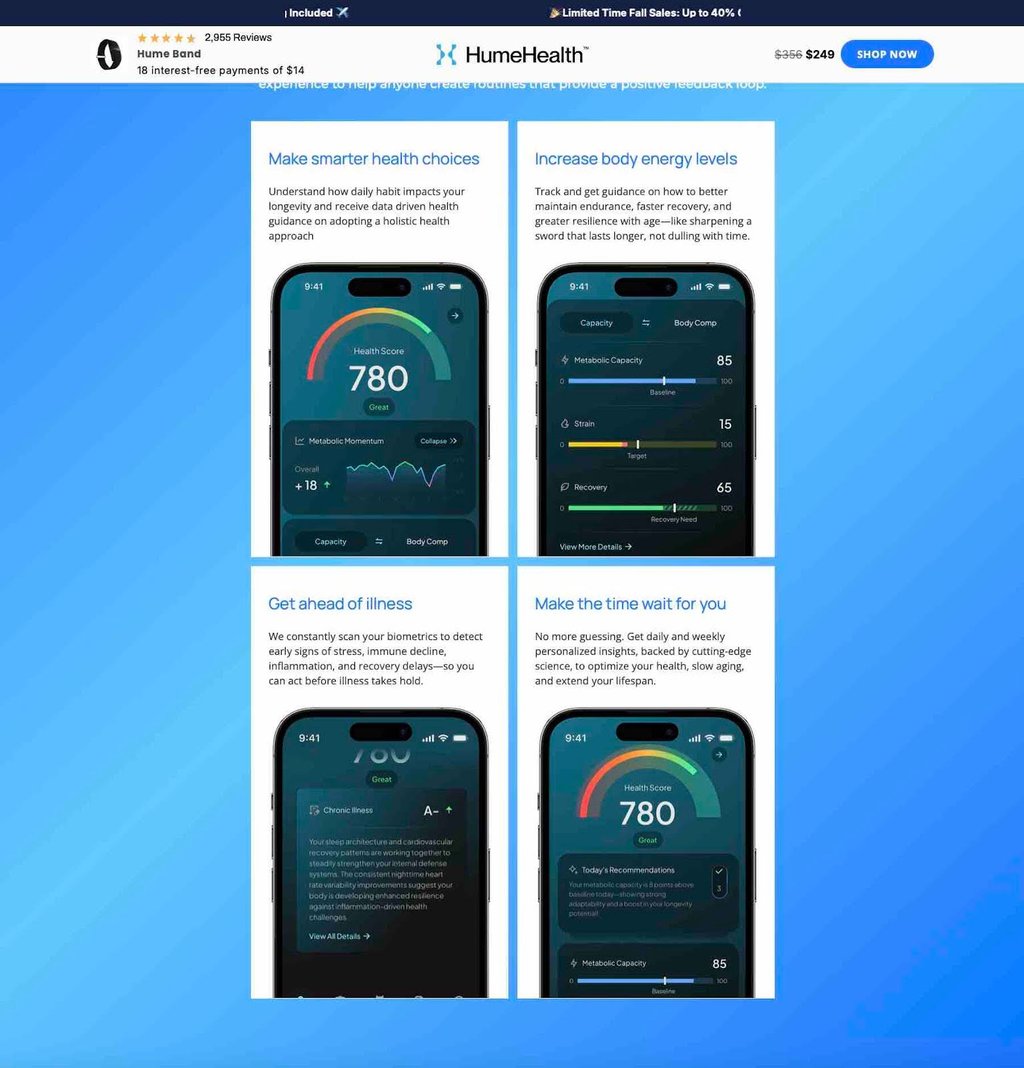
- Sleep details. Hume Band tracks total sleep, including deep, REM, light, and awake percentages, and also provides insights into sleep quality and sleep debt.
- Activity and strain insights. The device computes steps, active minutes, and zone minutes (Z2/Z3/Z4), as well as active calories. It provides an overall Strain Score.
- Continuous biometric monitoring. Hume Band constantly tracks key biometrics to help users stay aware of changes that may affect their well-being.
- Manufacturing quality. The device is IP68-rated, meaning it’s legitimately dustproof and water-resistant (up to one meter for up to two hours). The comfortable and modern SuperKnit strap fabric with the metal clasp is designed for non-stop wear.
- Safety and certifications. The Hume Band is EMF-safe, FCC-certified, and gets automatic firmware updates.
- Hume Pod add-on. The Hume Pod ($199.00) scans body composition vs body fat, and muscle mass. It integrates with the Hume Band for additional trends in the app.
Benefits of Hume Band
Below are the most talked-about key benefits of Hume Band.
Validated sensors
The Hume Band tracks a wide range of health metrics simultaneously, including resting heart rate, HRV, baseline SpO2, and respiratory rate. Hume Health states that its sensors and algorithms are lab-tested and designed to provide accurate readings over time. While independent verification of these claims is not publicly available, the band’s long-term tracking can still help you observe trends and patterns in your biometrics for personal insight.
Clinical-grade accuracy
Hume Health claims that the Hume Band is an award-winning device with top-notch accuracy validated in lab studies and third party testing, but these studies are not yet available to the public. The company also says it’s working on FDA approval for some features – an indicator of professionalism and transparency.
The company also claims its products are designed by human performance experts and used by healthcare and sports professionals. With the premium program, you get Holistic Health Coaching that’s said to be science-backed, though further validation is not provided.
On Hume Band’s website, there are even testimonials by a professor, a clinical assistant, and an author who writes about longevity, all good signs regarding the band’s versatility.
Distraction-free use
The Hume Band is all about minimalism and quiet data-gathering without screens, calls, or social media distractions. It’s designed not to attract attention and be comfortable enough to wear while working out, showering, or sleeping. The app also isn’t invasive, as it just quietly crunches your data, providing you with daily and weekly takeaways.
User-friendly interface
The Hume Health app is simple enough for beginners, with more detailed breakdowns available with a single tap. Key metrics are large, colorful, and immediately visible.
You’ll see entertaining, modern visuals like rings, scores, and trend lines that aren’t overwhelming. You can swipe health categories and toggle between trends, so it’s impossible to get lost. And if you're new, you get step-by-step guidance during setup.
Hume Band: user reviews
I’ve spent time reading through dozens of verified user reviews to get a realistic sense of how the Hume Band performs in everyday life. Many users appreciate its health-first approach and the longevity metrics, with some saying the readings meet expectations. People liked features such as the IP68 water resistance, integration with the Hume Pod, and responsive customer support.
At the same time, several recurring issues came up that are important to highlight. Some users reported battery life lasting only 2–4 days, while others experienced inconsistent sleep or activity tracking, with sleep totals sometimes showing just 2.5 hours out of an 8-hour night or step counts doubling actual numbers. A few users also faced defective heart rate sensors and difficulties obtaining refunds.
From reading these reviews, my impression is that while the Hume Band can offer meaningful insights for health-conscious users, it still has reliability and hardware issues that prospective buyers should be aware of.
Hume Band pricing and subscriptions
Regarding pricing and subscriptions, the Hume Band is advertised as a one-time purchase, currently listed at $229.04 (discounted from $356.00). A subscription isn’t required for full device functionality, and Premium is an add-on at $8.99/month.
The Hume Band is HSA/FSA eligible, includes a one-year warranty (10 years is $50.00), and a 30-day return policy (from receipt date). Interestingly, even used and opened products can be returned. Regarding shipping, there’s free worldwide shipping on orders over $20.00, and most orders are shipped within one business day and delivered in 3-5 business days.
I think the cost of the device is justified, especially since you can just return it, even opened, if you don’t like it. The Hume Band is placed about mid-way among its rivals. For instance, WHOOP has a much better ecosystem, but you’re tied to an ongoing subscription costing up to $359.00/year for the top model. Meanwhile, the simple Amazfit Helio strap is only $99.00, but with fewer features and less validation.
Hume Band vs competitors
When people research health trackers, they’re often comparing the Hume Band to market leaders like WHOOP and Oura Ring, especially on key factors like ongoing costs, battery life, and what each device focuses on. Here’s how they compare when put side by side:
| Provider | Subscription requirement | Battery life | Cost model | Core focus | Data depth | Form factor |
| Hume Band | No mandatory subscription; optional premium for AI insights | Up to 5–7 days per charge | One‑time purchase with optional monthly add‑on | Longevity and metabolic trend metrics | Metabolic Capacity, Metabolic Momentum, sleep and vitals | Wrist band |
| WHOOP | Subscription required to access most features | Typically 5–7 days (advertised longer on some models) | Membership payment (often yearly or multiyear) | Recovery, strain, sleep insights | Strain and recovery algorithms with community features | Wrist/arm band |
| Oura Ring | Subscription required for full insights and advanced data | Up to 7–8 days depending on use | Hardware cost plus subscription | Sleep, readiness, activity tracking | Deep sleep and readiness metrics with lifestyle context | Finger ring |
Final verdict: who the Hume Band is for
The Hume Band is best suited for users who want a longevity-focused, distraction-free health tracker. Its long-term trend tracking, metabolic and sleep metrics, and optional AI coaching make it appealing to anyone starting their wellness journey or switching from subscription-based devices like WHOOP.It’s less ideal for users who need precise workout tracking, real-time stats during exercise, or a built-in screen. Athletes or power users who rely on detailed activity feedback may find it limiting compared with smartwatches or performance trackers.
Hume Band is best for:
- Longevity-focused users
- Beginners or casual health trackers
- WHOOP switchers looking to avoid subscriptions
Hume Band is not ideal for:
- Athletes needing detailed workout metrics
- Users who want a display on the wrist
- Those expecting fully clinically validated metrics
Overall, Hume Band offers a simple, insightful approach to personal health trends with a focus on long-term wellness rather than short-term performance.
FAQ
Is Hume Band worth it?
The Hume Band is worth it if you’re looking for a longevity-focused, distraction-free health tracker that monitors long-term trends without a subscription. However, it’s not ideal for athletes or anyone needing precise workout metrics or a screen on the device.
What health metrics does the Hume Band track?
Hume Band tracks resting heart rate, heart rate variability, heart rate consistency, baseline SpO2, SpO2 consistency, cardiovascular health score, sleep architecture metrics, sleep quality score, sleep debt, activity and strain, recovery metrics, and metabolic metrics.
Does Hume Band require a subscription to use all features?
Yes, you need the Premium ($8.99/month) membership to use personalized, AI-boosted coaching and feedback. Besides those features, it’s free to use all of the essential core metrics and trends.
How accurate are Hume Band’s health measurements?
Hume Band provides health measurements across a wide range of metrics, but the company does not publish independent verification or specific accuracy percentages. Users and reviewers rely on real-world trends rather than confirmed lab data to assess reliability.
Is Hume Band compatible with both iOS and Android?
Yes, it works with iPhone 8 or newer running iOS 14.0 or later, and with Android devices running version 8.0 (Oreo) or higher.
How does Hume Band differ from other fitness trackers?
Hume Band is not subscription-based, focuses on longevity metrics, and is screenless, setting it apart from most other fitness trackers. This makes it ideal for users who want long-term health insights without distractions or ongoing fees.
How does Hume Band compare to WHOOP?
Hume Band doesn’t need a subscription and focuses on long-term health, while WHOOP emphasizes athletic tracking and recovery. It’s also screenless and designed to be simple to use.
What is the actual battery life of the Hume Band?
The Hume Band’s battery typically lasts around 5–7 days per charge in real‑world use. It may vary depending on how much you sync and which features you use.





Your email address will not be published. Required fields are marked